
Academic Practices
Best Practices in Academic Processes and Teaching–Learning at Thiagarajar College of Engineering
Introduction
Thiagarajar College of Engineering (TCE), Madurai, has established a distinctive academic ecosystem that promotes excellence in engineering education through continuous innovation in curriculum design, teaching–learning methodologies, assessment, faculty development, and educational research. The institution has progressively transformed its academic processes by embracing Outcome-Based Education (OBE), competency-based curriculum design, Choice Based Credit System (CBCS), CDIO framework, technology-enabled learning, and evidence-based pedagogical practices. These initiatives collectively create an educational environment that nurtures academic excellence, innovation, employability, ethical responsibility, and lifelong learning, while aligning with the objectives of the National Education Policy (NEP) 2020.
Curriculum Innovation and Academic Flexibility
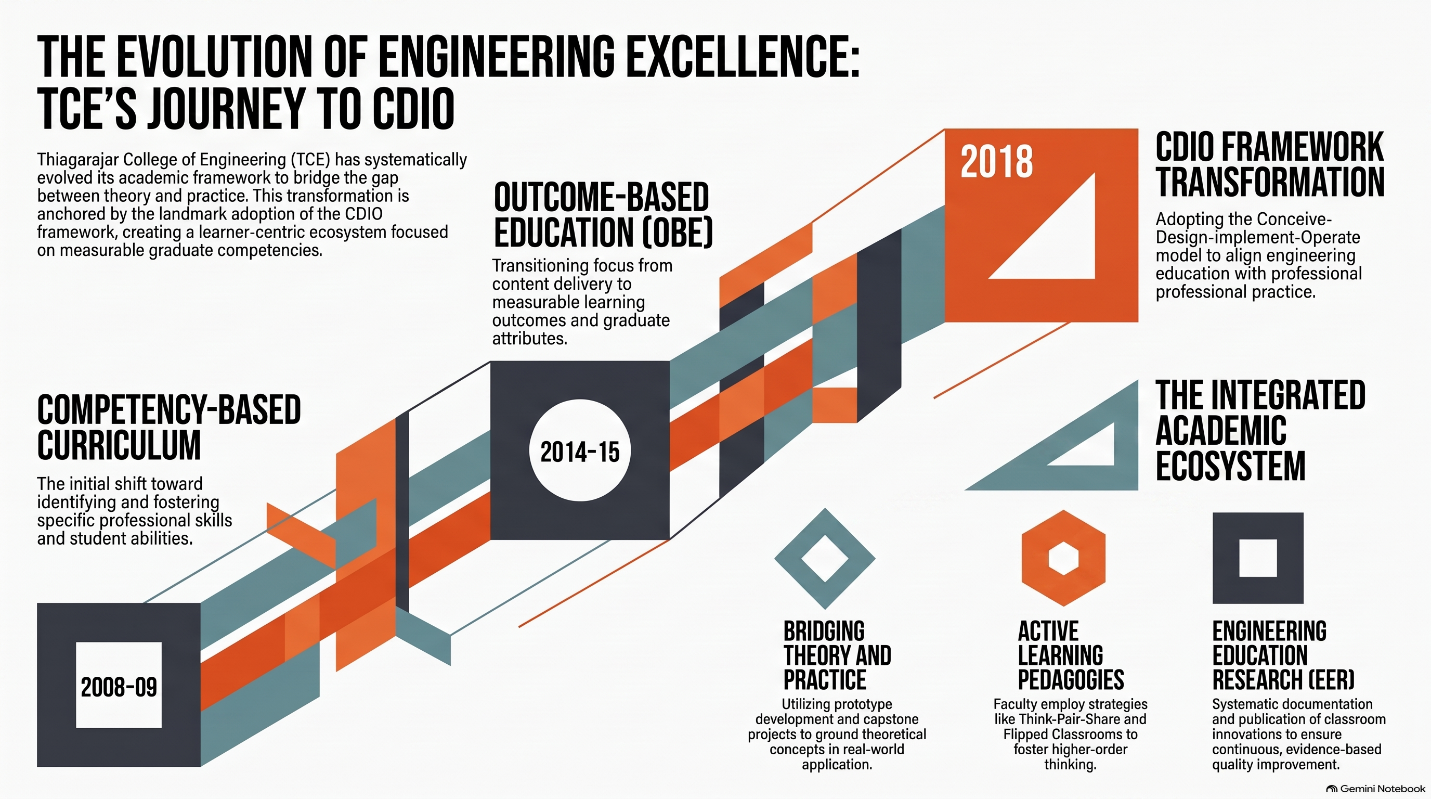
One of the hallmarks of TCE is its proactive curriculum reform. The institution introduced a Competency-Based Curriculum as early as 2008–09, followed by Outcome-Based Education (OBE) in 2014–15 and CDIO reforms in 2018. These reforms have shifted the focus from content delivery to measurable learning outcomes and graduate competencies.
The curriculum is enriched with several innovative course types that promote multidisciplinary learning and practical competence, including:
Engineering Design Courses
Capstone Projects
Guided Study Courses
Foundation and General Electives
Flexible Electives
Industry Supported Courses
Theory-cum-Practical Courses
Fully Internal Assessment Courses
CDIO (Conceive–Design–Implement–Operate) based learning experiences
These curriculum innovations provide students with flexibility to pursue their interests while simultaneously strengthening problem-solving, design thinking, innovation, entrepreneurship, and professional competencies.
Student-Centred Teaching–Learning Practices
TCE adopts a learner-centric approach where classroom instruction is transformed from passive knowledge transfer into active knowledge construction. Faculty members systematically employ evidence-based active learning strategies such as:
Think–Pair–Share (TPS)
Think Aloud Pair Problem Solving
Jigsaw Learning
Group Grid Activities
Flipped Classroom
Collaborative Learning
Project-Based Learning
Inquiry-Based Learning
Simulation-Based Learning
Design Thinking
These pedagogical approaches encourage student participation, collaborative problem solving, higher-order thinking, and reflective learning, thereby improving conceptual understanding and long-term knowledge retention. ICT tools, virtual laboratories, blended learning, MOOCs, and Learning Management Systems are effectively integrated into classroom practices to create engaging and flexible learning environments.
Course plan is designed to integrate teaching learning practices along with formative assessment.
Experiential, Industry-Integrated and CDIO Education
Experiential learning forms the core of TCE's academic philosophy. The institution has successfully embedded the CDIO framework across several engineering programmes to bridge the gap between theoretical concepts and engineering practice. Students engage in engineering design, prototype development, laboratory experimentation, community-based projects, industrial problem solving, internships, and capstone experiences that mirror professional engineering environments.
The institution further strengthens industry relevance through industry-supported courses, engineering practices in community services, virtual laboratories, remote experimentation, and real-world projects. Such initiatives significantly enhance students' design capability, innovation, teamwork, communication, and employability skills.
Innovative Assessment Practices
Assessment at TCE extends beyond conventional examinations and emphasizes continuous evaluation of student learning. Bloom's Taxonomy is systematically integrated into question paper design and evaluation processes to assess varying cognitive levels. Flexible assessment strategies are adopted depending on the nature of the course, while rubric-based evaluation ensures transparency and consistency in assessing projects, presentations, design activities, and laboratory work.
Modern digital assessment tools and analytics are also employed in postgraduate programmes to provide timely feedback and facilitate continuous improvement. This outcome-oriented assessment framework ensures that evaluation remains aligned with the intended learning outcomes and graduate attributes.
Faculty Development and Scholarship of Teaching–Learning
Recognizing that educational excellence begins with empowered educators, TCE invests substantially in faculty capacity building. As an IIT Bombay Remote Centre since 2012, the institution has organized numerous workshops and Faculty Development Programmes (FDPs) in collaboration with IIT Bombay and IIT Kharagpur covering engineering disciplines, educational technology, ICT-enabled learning, blended teaching, algorithms, research methodology, Python, Moodle, cybersecurity, and pedagogy.
Faculty members actively participate in International Engineering Educator Certification initiatives, Quality Enhancement in Engineering Education (QEEE), and global collaborations that strengthen their pedagogical competencies. The institution also promotes internal faculty conclaves and peer learning communities where educators share innovative classroom practices and continuously refine instructional methodologies.
An outstanding feature of TCE is its strong culture of Engineering Education Research (EER). Faculty members regularly publish research on blended learning, adaptive gamification, AI-assisted education, project-based learning, CDIO implementation, virtual laboratories, formative assessment, student engagement, learning analytics, emotional intelligence, educational data mining, design thinking, and innovative assessment frameworks in reputed international journals. This strong research ecosystem enables evidence-based educational innovations and contributes significantly to national and international engineering education literature.
Global Learning and Multidisciplinary Education
TCE extends learning opportunities beyond the conventional curriculum through globally mentored multidisciplinary courses delivered by internationally renowned experts from universities such as Purdue University, Arizona State University, UC Davis, Oklahoma State University, and other institutions. Recent offerings include:
Leadership and Sustainability
Artificial Intelligence for All
Design Thinking
Entrepreneurial Thinking
These programmes expose students to emerging technologies, sustainability, innovation, entrepreneurship, and global perspectives while fostering interdisciplinary thinking, leadership, and problem-solving skills that align with the aspirations of NEP 2020.
Continuous Quality Assurance
Quality enhancement at TCE is supported through systematic academic planning, standardized course plans, student satisfaction surveys, structured feedback mechanisms, academic templates, and continuous monitoring of teaching–learning processes. The Academic Process Team plays a central role in reviewing practices, introducing innovations, monitoring implementation, and promoting continuous improvement across departments. Standardized documentation and regular feedback enable evidence-based decision making and sustained quality assurance.
Institutional Impact
The collective implementation of these best practices has created a vibrant academic ecosystem characterized by:
Strong alignment between curriculum, pedagogy, assessment, and graduate outcomes.
Enhanced student engagement through active, collaborative, and experiential learning.
Improved employability through industry integration and design-based education.
Increased faculty scholarship in engineering education and educational technology.
Extensive adoption of digital learning platforms and blended learning.
Promotion of multidisciplinary education, innovation, entrepreneurship, and sustainability.
Continuous improvement driven by evidence, feedback, and educational research.
Faculty Development, Digital Learning Ecosystem and Educational Innovation
A distinctive strength of Thiagarajar College of Engineering is its systematic investment in continuous faculty development and the establishment of a vibrant teaching–learning ecosystem. The institution recognizes that sustainable academic excellence is achieved only when faculty members continuously update their pedagogical knowledge, domain expertise, and educational research capabilities.
In-house Faculty Development Programmes
Beyond externally sponsored Faculty Development Programmes, TCE has institutionalized In-house Faculty Training Programmes that function as an internal knowledge-sharing platform. Experienced faculty members regularly conduct workshops, hands-on sessions, peer demonstrations, and faculty conclaves on innovative pedagogies, outcome-based education, active learning, assessment design, educational technologies, AI-enabled teaching, blended learning, and curriculum development. These programmes cultivate a collaborative culture where best classroom practices are shared across departments, enabling rapid adoption of educational innovations throughout the institution. This peer-learning ecosystem has significantly contributed to improving teaching quality and maintaining consistency in academic processes.
MOOCs and Lifelong Learning
TCE actively promotes a culture of lifelong learning through extensive adoption of Massive Open Online Courses (MOOCs). Faculty members and students are encouraged to enrol in globally recognized online courses offered by leading universities and professional organizations. The institution further enriches learning by offering multidisciplinary courses delivered by internationally renowned experts in areas such as Artificial Intelligence, Design Thinking, Leadership and Sustainability, Entrepreneurial Thinking, and Data Analytics. These initiatives broaden learners' perspectives, foster interdisciplinary competencies, and provide exposure to emerging technologies and global best practices.
Neo CoLab – Collaborative Educational Innovation
TCE has established Neo CoLab as a collaborative platform that promotes innovation in teaching and learning through interdisciplinary interaction among faculty members. Neo CoLab provides opportunities for educators to co-design instructional strategies, experiment with emerging educational technologies, integrate Artificial Intelligence into teaching, develop innovative learning resources, and collaboratively solve pedagogical challenges. The platform nurtures a community of practice where continuous experimentation, reflection, and knowledge exchange drive sustained academic improvement.
Engineering Education Research (EER): Closing the Quality Improvement Loop
One of the most distinctive academic practices at TCE is the systematic documentation, evaluation, and publication of academic reforms as Engineering Education Research (EER). Rather than implementing innovations in isolation, faculty members rigorously study their effectiveness using educational research methodologies and disseminate the outcomes through high-quality research publications.
Every year, innovative practices—including CDIO implementation, blended learning, adaptive gamification, AI-assisted teaching, project-based learning, virtual laboratories, formative assessment, student engagement, learning analytics, emotional intelligence, design thinking, and technology-enabled learning—are documented, validated through empirical studies, and published in reputed journals such as the Journal of Engineering Education Transformations, Journal of Applied Research in Higher Education, International Journal of Human–Computer Interaction, and other peer-reviewed international journals.
This unique practice transforms classroom innovations into scholarly contributions, enabling evidence-based decision making, continuous quality enhancement, institutional learning, and national dissemination of successful educational practices. It also reinforces TCE's position as a leading contributor to Engineering Education Research in India, ensuring that teaching innovations are continuously evaluated, refined, and scaled across programmes.